

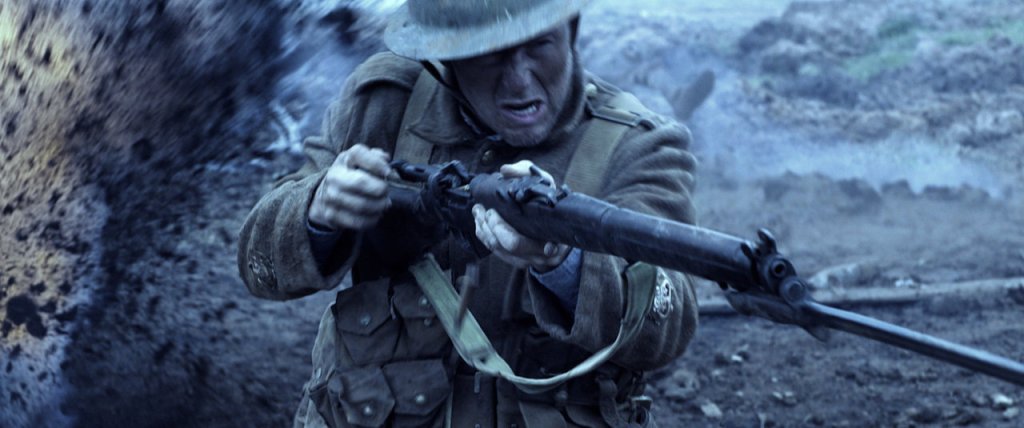
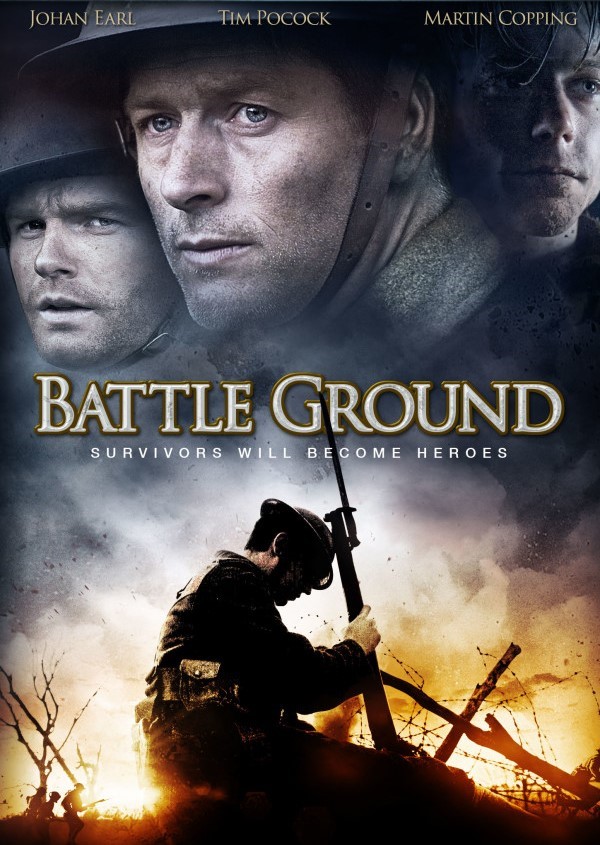
Battle Ground was directed by Johan Earl and Adrian Powers, written by Earl, Travis Spiteri, and Denai Gracie and stars Earl, Tim Pocock, Martin Copping, Denai Gracie, and Sarah Mawbey. It follows a group of British soldiers trapped in no man’s land in France and the choices that one of the men’s wives must make in the meantime.
The Plot: The makers of this movie were certainly trying to make an impression via the uncommon setting, with the relatively untapped cinematic potential of the first World War, they had a chance to make something unique, but their narrative execution is largely mixed.
1916, France; the lines between the British and the German forces have yet to be altered by charges from the British, and now the company Lieutenant instructs Sgt. Maj. Wilkins (Earl) to lead yet another charge. It’s an instantly recognizable situation and the objective is simple and compelling enough to watch. Wilkins begins the new assault and is knocked unconscious. When he wakes in the dark of night, there aren’t many men left aside from Pvt. O’Leary (Pocock) and the wounded Cpl. Jennings (Copping), who now need to work their way back to their side.
Between the progression of the three men’s journey, the movie cuts back to Wilkins’s wife Grace (Gracie), who’s going through her own problems on the home front with the assistance of Eve (Mawbey). For 40 minutes, all that’s shown of Grace is a brief glimpse while the men on the frontlines get their bearings. The script introduces a strong, dramatically ironic time restriction on the trio, who will be annihilated by friendly fire if they don’t make their way back to their side by morning. It’s simple. Arguably too simple for a 95-minute runtime, which works for long stretches but could’ve used some kind of intelligence grab or small German trench for the Brits to get involved with on their returning crawl.
Instead, the filmmakers offer a poorly balanced helping of domestic perspective, which comes across as a cork to plug the gaps, but at least never attempts to shuffle the prioritization of events. Simplicity is one thing for a movie of this nature, but there’s a breaking point that Earl and Powers couldn’t cover.
The Characters: All-time greats with wartime settings like Hacksaw Ridge, Saving Private Ryan, and Platoon started out with everyman soldiers battling for survival, but during the downtime they were crafted by the scripts and acting into real people. Battle Ground tries the same approach but doesn’t succeed.
Wilkins’ characterization comes almost entirely from the notepad containing Grace’s picture he whips out at every possible opportunity. The opening of the movie starts with his writings as narration which gives perspective on the conflict and his relationship with Grace, but the script has nothing else for him to be, as that notepad comes out at least 3 times in the first 35 minutes. Through his actions it’s clear that he’s the hero type, encouraging his men to keep them moving and dragging Jennings as far as possible under fire.
O’Leary is a stereotypical FNG who’s not yet accustomed to the sights and sounds of war. At first he’s frequently hesitant to follow Wilkins’s orders, which put them all at risk to get them back to their trench, but he sucks up all of his fears over time and begins to become a part of the makeshift unit organically. Jennings has a back and forth with Wilkins, in some rough expository backstory, but is just another wounded soldier cracking jokes at his wounds and unlikely odds of survival.
Grace is absent for the first half of the movie, which is a surprisingly good thing considering her actions. During her first appearance, she’s worrying about her husband’s potential reactions to finding out that she cheated on him while he was off fighting. It’s not a good place to start, and she doesn’t develop much by the time the movie reaches its conclusion.
Characters aren’t the strong suit of this movie, which sticks to archetypes that were moved away from, or at least beginning to be deconstructed by the mid-1970s, making it feel antiquated in the wrong ways.

The Drama: In a bold reach, the movie tries to tackle two different fronts of wartime: the home front and the western front. Minor successes are littered throughout Battle Ground, but they aren’t substantial enough to be consistently compelling.
Debuts don’t bring much promise, with the movie immediately simplifying the attitudes of the armed forces on both sides. The Lieutenant who sends Wilkins and the rest of the troops into the wasteland between lines is given the most surface level nonchalant dialogue about sending barrages of men to die that it’s laughable. The German forces are cold in the face of death, standing silent in the face of their fellow soldiers’ suffering. Some are even decked out with supervillain scars across their faces, and of course they’re the most calculating.
When the focus is on the three men caught in the middle, things get better, as the immersion increases with the scale of the no man’s land that they have to cross to reach a degree of safety. Differing opinions on the state of Jennings bring some minor squabbles and discussions into the mix, which pose some interesting questions about triage and valiance amid conflict. It’s not stellar, but watching the men struggle in the face of perceived futility can be harrowing at times, with the ticking clock element forcing decision making between option that are only slightly less risky than each other.
Valiance is the word most apt to describe the drama surrounding Grace and her dilemma; simply because the attempt to humanize a character like her is a jaw-dropping proposition. She’s been cheating on Wilkins since he’s been away and is now dealing with the consequences of those actions: pregnancy with another man’s child. Battle Ground tries to grapple with the options of abortion and coming clean and making Wilkins take care of an unrelated child, but they’re such bad options that all of the drama from the scenario is sapped and sent to Wilkins himself, which forces the audience to choose whether or not they’d rather see him come home to heartbreak in either outcome or perish on the field.
Some situations with heft come out of the main events of Battle Ground, as it does a solid job at portraying the hard place the men are in, but whenever it deviates from them, the results range from cartoonish to infuriating.
The Technics: Earl and Powers’ movie is a low budget Australian production with an Australian cast, and it’s surprising in its prowess, but begs more questions than perhaps it should.
Confounding is the insistence on focusing on British forces, considering the Australians fought in World War One on almost every front, so making the Australian actors don uniforms and accents of the British is confusing, especially when the voices from down under are hardly heard in war movies. Thankfully, those uniforms, as well as the makeup, production design, sound design, and pyrotechnics are more than convincing, more so when factoring the limited resources available.
Earl and Powers do a good job directing the action sequences and exchanges between characters, framing events in a way that keeps the stakes in mind and the setting oozing with atmosphere. Some clever editing is done too, with transitions being stellar and fluid. The writing is all over the place in terms of quality, but the visual aspects are rewarding.
Battle Ground strains itself on more than one occasion. Its compulsion to visit the domestic side does damage to the pacing and drama, but the plot and stakes are passably engaging and well produced enough to be a watchable, if underwhelming, WWI movie.
50/100
Misc details
Release date (US): November 26, 2013
Distributor: Lionsgate Films
Runtime: 95 minutes
MPAA rating: R
 ManVsMovies.com
Leave a comment