

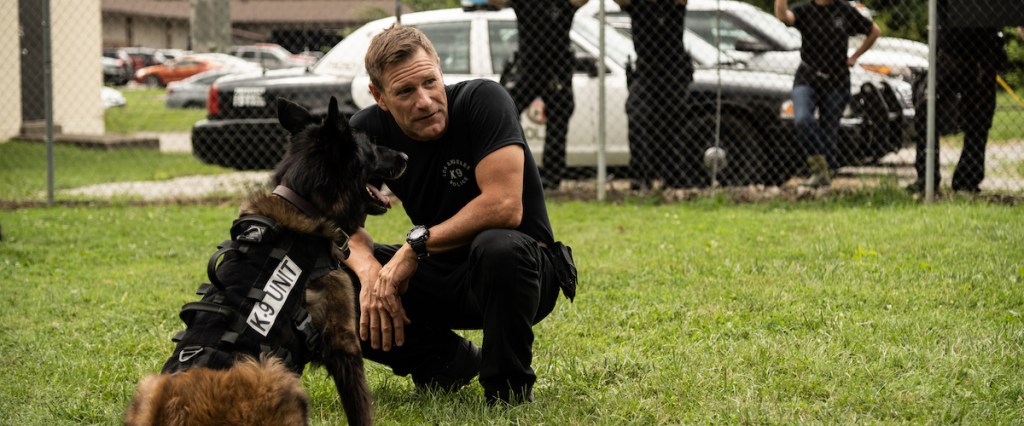

Muzzle was directed by John Stalberg Jr., written by Stalberg Jr. and Carlyle Eubank, and stars Aaron Eckhart, Delissa Reynolds, Penelope Mitchell, Stephen Lang, and Nick Searcy. It follows a police officer as he falls into a network of illicit activities while trying to solve the murder of his police K9 unit.
The Plot: Despite the presence of an interesting partner and having the setting of modern California – a veritable no man’s land – Stalberg and Eubank don’t have a story sufficiently different enough from numerous other crime movies to tell, although what they came up with is still largely competent.
On patrol in Skid Row, officer Jake Rosser (Eckhart) and his canine partner, Ace, get a call for backup on a crime in progress. In an ensuing shootout, the suspect, a fellow officer, and Ace wind up dead and Rosser in hot water with Captain Freeman (Searcy) for assaulting the medic that neglected the dog. Some clues were mentioned prior to the fight, which should send Muzzle straight into the underground, but unfortunately there’s a subplot involving Rosser developing a relationship with Mia (Mitchell) that stands in the way temporarily.
Later, our protagonist visits Leland (Lang) and pairs up with Socks, a former narcotics dog with titanium teeth, and restarts the plot, and it goes where many have before all while trying to balance itself with more dramatic tendencies. Rosser soon creates and manipulates his own investigation with help from detective Ramos (Reynolds), which unsurprisingly leads to a drug operation being run in the area.
Once Muzzle lets the characters and the audience in on who’s running the fentanyl ring (which is rather absurdly presented), it reaches plot capacity, as scenes of Rosser and Ramos getting chewed out by Freeman, downtime with Mia, and busting the operation all fight for screentime. The destination is familiar, but rather abrupt, however the movie still maintains a decent story overall.
The Characters: Silence can speak more effectively than words when written and acted correctly, which is the idea behind the movie’s primary pair. Although the filmmakers insist on making metaphors too often, the chemistry and development works well.
Rosser has some prerequisite traits that come off as a bit too generic, such as a previous run of service in the Marines and a PTSD diagnosis, but it’s his steeliness and rejection of almost all communication, positive or negative, that makes him interesting. He doesn’t say much, but most is understood. His lack of visible grieving (though there is a bit at Ace’s funeral), minimal interaction with fellow officers, and willingness to admit that his anger gets the job done prop up the idea that he’s broken; but thanks to man’s best friend, not beyond repair.
Socks has a similarly rough but largely unspoken past. A victim not of a perp, but of the officer that commanded her – hence the few titanium teeth, there’s a justifiable distrust of authority for much of her time on screen. She’s just as hardheaded as her owner, which somehow allows for some tension between her and Rosser that eases over time. Needless to say, she can’t speak, but her eyes do a lot of conveying for her judgement of character. Socks is remarkably expressive, and that’s a high achievement.
Other characters are just here out of necessity, especially Mia. The script tries to go big with Freeman and the baddie to compensate, but it’s a miss. Still, the bond between the two officers keep each other alive and sympathetic to the audience, benefitting hugely from Eckhart and the dog actor’s (unfortunately unlisted, as best I can tell, but her coordinator David Allsberry is) performances.

The Crime: B-movies only really need that one good idea to have an edge over the competition. A topical choice in narcotics and some above average procedural elements put Muzzle that little bit higher.
Canines and how they’re used in law enforcement are the brightest spot among the facets of criminal activity here. It’s an untapped idea, as a primary ingredient of a film anyway, and it may seem to be a mere gimmick, but Stalberg and Eubank make it authentic. As Leland explains during Socks’ training, the dogs can run faster, jump higher, and track better than any human can, and all of those talents get used frequently throughout the movie. What’s even more interesting is Muzzle’s visualization of K9 cons, as the German Shepherds used respond to that language, making a perp who knows specific phrases an exponentially bigger threat.
Procedural elements tie in directly with that idea, as Rosser’s theory of corrupt cops is kept in mind. However, the filmmakers take their time to come back to that, as Rosser’s primary focus and sources of information are Los Angeles’ homeless population, which is another smart transmogrification of typical ideas, and Ramos’s intel. While this does mean there are some contrived methods of police work (Rosser is basically handed a know-it-all informant and Ramos just makes leads appear when needed), the shakedowns, manipulation, and tailing are still good enough.
Although the operation and culprits are eventually attended to, Muzzle leaves it relatively faceless. From an artistic standpoint, it’s understandable, but the earlier attempts in creating opulent antagonists don’t gel with how they create and distribute their product, which is relatively grounded and fairly plausible. By the end, the illicit activities are more interesting than most, but eventually sputter out with unconvincing resolutions.
The Technics: On a surface level, the finished film is a handsome production for its low budget and relatively new helmer. However, an identity crisis bubbles to the top of the movie, undoing some of its stylistic choices and forcing a heavy hand to mitigate its issues.
I’m sure most people know that Hollywood is home to the movies; most filmmakers want to make their hometown and industry hub look as good as possible, but Stalberg makes some bold choices that give a tremendous level of identity to Muzzle. Modern L.A. is superbly captured, with debris, passed out vagrants, loose needles, and graffiti plentiful for most of the movie; during the time where this is unseen, there’s constant pushback against exposing the status quo. Alongside this and the color palette of sickly greens, yellows, greys, and pitch black corners, it’s never a question if Rosser and Socks are in the thick of it. Some other stylistic choices come from the use of dog-mounted cameras, which is another dose of reality that acts as a calling card for the feature. As said, it’s a solid production.
Some of the writing, as well as the final cut of the movie, bring it down by a very noticeable measure. Trying to put the officers on as equal a level as possible means the script has plenty of parallels between them, which are pretty obvious. It’s the writers’ constant spoken reminders that make the comparison an annoyance at times, as well as poorly paced exposition and Mia’s entire existence in the movie that make it warrant another round of editing.
Muzzle does eventually boil down to being more generic than it should be, and in a dog eat dog world, that’s a major fault. However, the well-executed cornerstone, solid acting, and palpable atmosphere keep it a hair above average.
63/100
Misc details
Release date (US): September 28, 2023
Distributor: RLJE Films
Runtime: 100 minutes
MPAA rating: Not Rated
 ManVsMovies.com
Leave a comment