

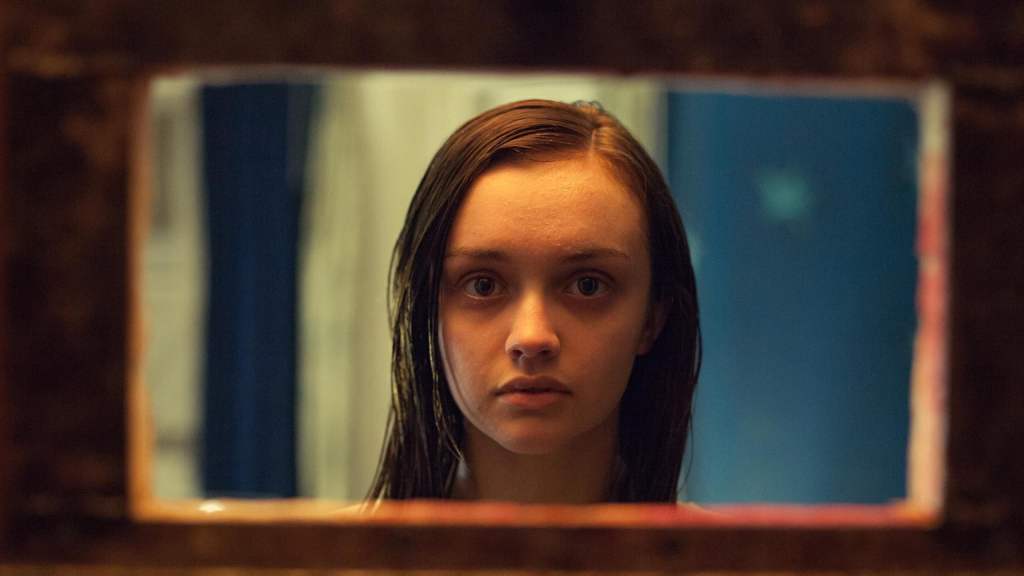

The Quiet Ones was directed by John Pogue, written by Pogue, Craig Rosenberg, and Oren Moverman, and stars Jared Harris, Sam Claflin, Olivia Cooke, Erin Richards, and Rory Fleck Byrne. It’s about a university professor and his students who experiment on a young woman to excise her of an evil energy that may be their undoing.
The Plot: Seldom is the plot of a horror movie its greatest strength, but with The Quiet Ones, there’s an interesting moral dilemma and engrossing conflict at the center. While never reaching too far out of the box, there’s at least something to attend to here.
In 1974 England, college professor Coupland (Harris) is preparing to prove to his students that supernatural activity is merely a disease that can be isolated and cured – an interesting proposition. Said experiment involves drawing negative energy out from a seemingly possessed girl named Jane (Cooke) and containing it within an object. The screenwriters have a lot to use with this setup, and they take their time setting up the process, with Coupland recruiting Krissi (Richards) and Harry (Byrne) to assist him and Brian (Claflin) to document the project.
Pogue, Rosenberg, and Moverman maintain intrigue, with the experiment getting its funding cut before it can begin, forcing the scholars to relocate to an isolated manor. The Quiet Ones moves forward with the assertion that psychological torture can make Jane so discontent that she will project her assumed illness onto a doll that looks like one she sees in her mind. Maybe the film is set a little too close to the present for that to sound like a plausible theory, but it works to start a conflict that moves the feature forward, as Brian’s sympathy and desire to understand Jane’s history drives a wedge in the already slow process. This allows doubt to set in, creating a moral back and forth until the collegiates can attribute coincidental happenings to science or supernatural.
A narratively rich and mysterious story works to sustain interest for longer than most cheap horror movies can muster. Even if The Quiet Ones capitulates to a bland ending befitting its contemporaries, the ride there is thoroughly investing.
The Characters: Unfortunately, the characters conducting and receiving the experiment are all one-note cutouts that bring no additional angles to the story. The screenplay elects to ignore both form and function, even if the actors don’t share the approach.
Brian, despite being the link between the scientifically minded side and the increasingly haggard test subject, starts out leaning towards believing Jane and never changes. Of course, this facilitates the primary conflict, but it makes him a bit of a blank slate, as he’s provided with no backstory aside from his attachment to his 16mm camera and vague assertion that his parents’ disagreement on the subject of faith has affected his own attitude; this doesn’t seem to be the case. His increasing attraction to Jane almost gives him dimension, but it doesn’t pan out.
Coupland is the overly cynical man of science that’s present in almost every science versus faith feature, denying any possibility of Jane’s bereavement being something tangible, or at least comprehensible. Is this realistic? Potentially, however, without any explanation as to why he thinks the way he does, he’s just the other side of the same generic coin that Brian (and the other, even less developed students) is.
Jane eventually gets a backstory, but it falls right in line with many a possession movie. While there’s not much else to her, The Quiet Ones at least makes her authentically accept the help she could potentially receive, which switches to resentment and back again. It’s simple characterization, but she’s far more human than the rest of the canned characters.

The Horror: Even with all of the basics provided to him by the script, Pogue’s outing is only scary when dealing directly with Jane. At all other times, the movie relies on the same cheap tricks used in the most desperate of would-be horror features.
Watching the supposed problem solvers address Jane’s plight with so much skepticism that it borders on negligence is easily the scariest that The Quiet Ones ever gets. Coupland and company’s insistence on the idea that the girl’s affliction can be forced out of her leads to a gradually increasing level of torment in hopes of reaching definitive results. They start out by locking her in a room with loud music being played endlessly to make her mad and scale upwards with tactics such as burning and beating. Seeing this escalation from people of science is unsettling.
Without any other cards to play, the helmer soon turns to jumpscares that repeat the same format over and over again. The music slowly fades out, the frame loses movement and dialogue, and a loud noise plays to jolt the audience. It works when used sparingly, but Pogue doesn’t know when to quit, often times resorting to false jumpscares to shock the audience. Perhaps the filmmakers hadn’t heard of the law of diminishing returns, as the feature becomes a monotone drag that’s propped up by the implications of its story rather than actual effort being put towards a sustained sense of dread.
The Technics: In the horror genre, filmmakers can get a lot out of a little, and The Quiet Ones is at least competently produced when taking its budget into account. It’s no benchmark of quality though, with uniformly routine production elements.
Visually, the only thing that stands out about the feature is its lighting style, which, while not great, at least allows the movie to be heard *and* seen instead of just heard due to the in-movie justification of needing to record the tests. Everything else, though, is adequate but unremarkable. The drab colors, limited (albeit handsome) location, and frequently handheld camerawork are all interchangeable with similar movies. Notably the director switches from found footage scenes to traditionally mounted ones, but this adds little and was probably done to appeal to the cinematic marketplace of the time, cheapening the experience.
Aurally unremarkable, the music by Lucas Vidal is filled with generic cues and tracks, but at least the soundtrack is period appropriate which shows at least some attention to detail that’s often lacking in other historically set horror movies. Stock crash and bump sound effects and obnoxiously loud sound design further keep the movie from being truly memorable from a technical perspective.
The Quiet Ones has softly disappeared from public memory, which is unsurprising due to its bland presentation and lack of scares. It’s a shame that the movie gets played so safely, as the plot is genuinely interesting, and the performances from Harris, Claflin, and Cooke are all praise-worthy.
40/100
Misc details
Release date (US): April 25, 2014
Distributor: Lionsgate Films
Runtime: 98 minutes
MPAA rating: PG-13
 ManVsMovies.com
Leave a comment